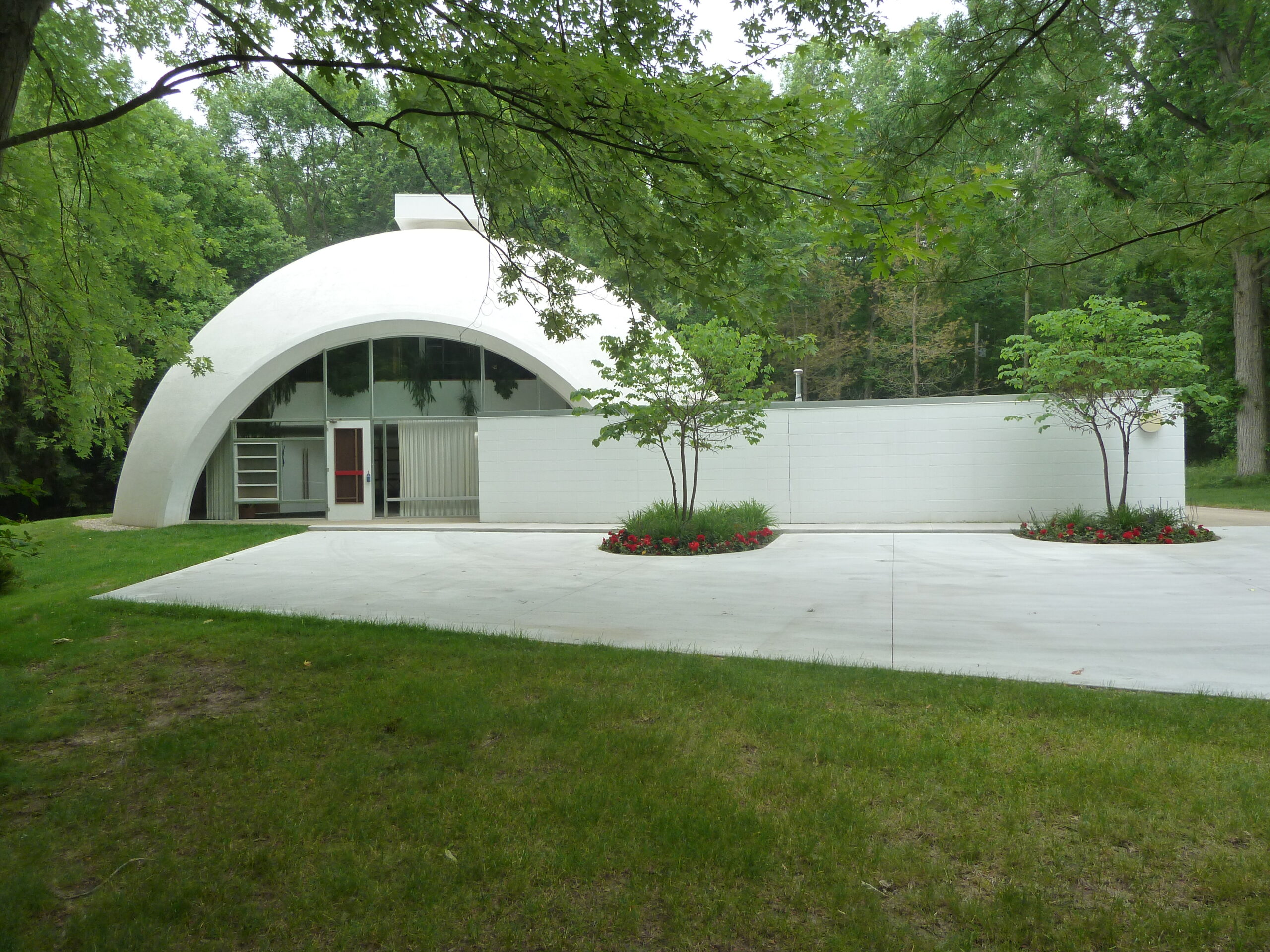
Constructed of Styrofoam and concrete using the Spiral Generation technique developed by the Dow Chemical Company, the Robert E. Schwartz House is located on an approximately three-quarter-acre wooded lot on West Sugnet Road in northwest Midland. A small stream cuts through the eastern edge of the property. The white, dome-shaped house contains three floors and approximately forty-three hundred square feet of living space. Three large arches, infilled with fixed panes and awning style windows set in aluminum frames, have been cut out of the dome to allow natural light into the interior and provide occupants with expansive views of the surrounding property. A small visor along the perimeter of the arched openings provides structural support as well as some protection to the window walls from rainwater runoff and direct sunlight. A tall, concrete block wall laid in a stacked bond extends west from the front elevation to screen the two-vehicle car port that projects from the southwest side of the structure. The box-like structure at the top of the dome is a skylight that provides natural light into the third floor. The interior spaces are arranged in an open floor plan. The living room, dining room and kitchen, along with a small office space are located on the first floor. The second floor, which has been held back from the exterior walls, contains four bedrooms and two baths. The third floor primarily functioned as a recreation space similar to a basement in a traditionally designed house.
The Schwartz House was designed by Midland architect Robert Schwartz for himself, his wife Barbara, and their three children. Initially interested in designing airplanes, Schwartz ultimately pursued a degree in architecture at the University of Michigan, graduating in 1954. At Michigan he had the opportunity to study under Buckminster Fuller. Under Fuller, Schwartz was one of a small number of students that participated in a project to design a prototype dome shelter to be used for camping by boys attending Camp Tamarack. It is said that his work with Fuller ultimately influenced his idea for constructing a domed house of his own. Upon graduation, Schwartz returned to Midland where he apprenticed with a few local architects including Glen Beach and Robert Goodall. Goodall, who studied at Taliesin and worked as a draftsman for Frank Lloyd Wright, later worked with Alden Dow, helping him to develop his unit block building system.
Schwartz collaborated with engineers at Midland's Dow Chemical Company about the materials that would be used for the dome. The Dow company had developed a "spiral generation" machine that would lay down layers of four-inch-thick Styrofoam in a dome shape. The layers of Styrofoam were fused together using heat and then the dome was sprayed with an approximately three-inch-thick coating of concrete. The structure then received an elastomeric finish coat developed by Dow Corning. The process of "spinning" the dome of the Schwarz House only took fourteen hours. Dow agreed to provide the equipment and materials for the dome in exchange for information on what it cost to fully fit out the house. The dome was completed in 1964, however, it took Schwartz another two years, working with help from his father, to complete the interior and make the house suitable for occupation. Schwartz occupied the house with his wife until his death in 2010. Under the guidance of Robert Schwartz Jr., an architect practicing in New York City, the house has undergone a sensitive renovation to preserve and enhance its original features.