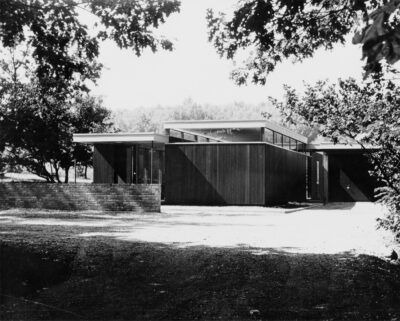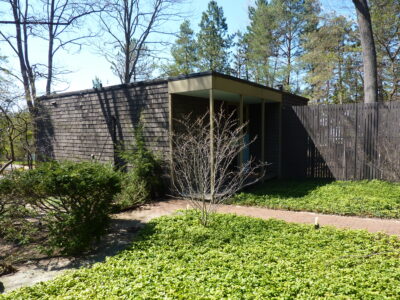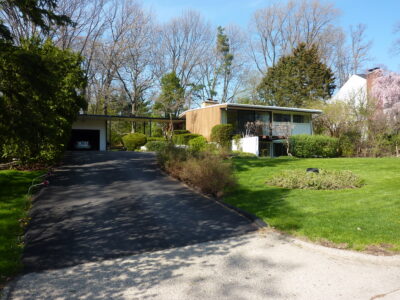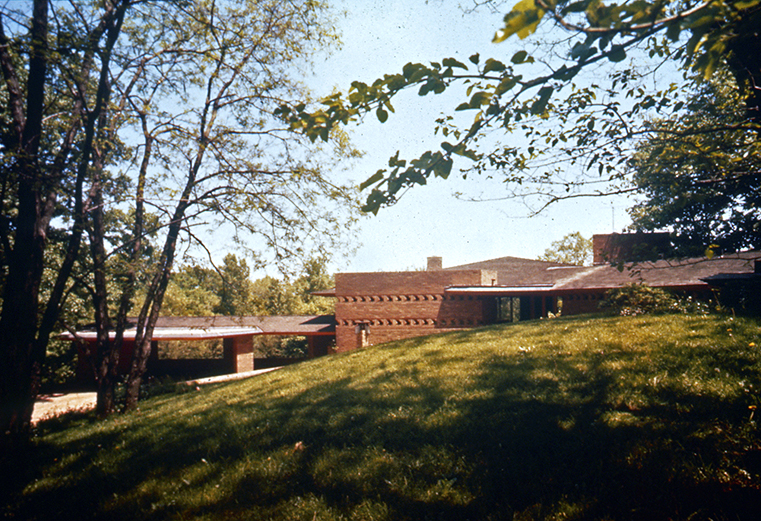

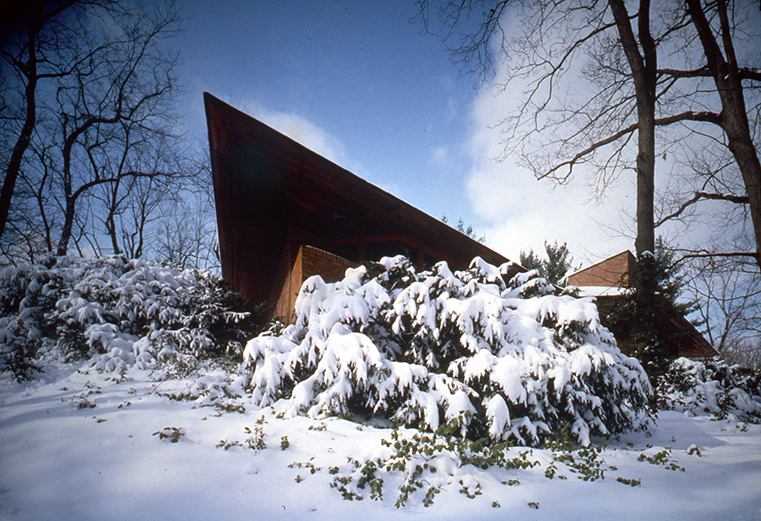
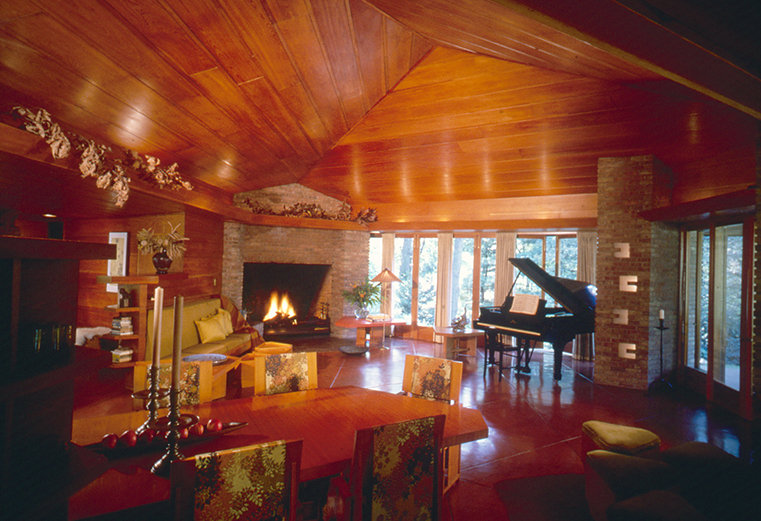
The William B. and Mary Shuford Palmer House is an approximately nineteen hundred-square-foot single family dwelling that is periodically made available for guest lodging and special events. The 1.5-acre property is comprised of three contiguous lots on Orchard Hills Drive east of downtown Ann Arbor near The University of Michigan’s Nichols Arboretum. The house sits on the highest point of the property with its southern wing set into the crest of the knoll or hogback. The plan of the house is derived from a geometry of triangles and parallelograms. The house has three wings that extend from the central entryway. The bedroom wing to the southwest, the living room and terrace wing to the east, and the carport to the north. Long dramatic low-slope hipped roofs with deep overhangs extend over each of the wings. The exterior is finished with brick and horizontal cypress boards and the roof is clad with cedar shingles and copper. The house is surrounded by an informal landscape planted with deciduous trees, evergreens, ground cover, shrubs and wild flowers. A small Garden House, constructed in 1964 and designed by Wright’s chief assistant, Jack H. Howe, is tucked into the side of a sloping hill southeast of the main house. The plan of the small building and the materials used in its construction mimic those of the main house.
William B. Palmer (b. 1907) spent his entire academic life at the University of Michigan. He earned his bachelor’s and master’s degrees in economics, taught in the Economics Department, and retired from the university in 1976. He was born and raised in Imlay City, Michigan, an agricultural center in Lapeer County. His father was a banker, and the family’s historic home on the main street is currently a funeral home. In 1937, William B. Palmer married Mary Wharton Shuford.
Mary Wharton Shuford (b. 1916) earned her bachelor of music degree from the School of Music, at the University of Michigan in 1937. She was born and raised in Conover, North Carolina. Her father, Adrian L. Shuford, was successful in business. Both her grandmother and her mother, Annie Shuford, who was the secretary of the State Association of Garden Clubs in North Carolina, instilled in Mary a love of learning and of gardening.
The William B. and Mary Shuford Palmer House, designed and built in 1950-51, is significant as one of the finest late works of master architect Frank Lloyd Wright (1867-1959). The house is considered one of the best of a long series of houses based on a module that is either an equilateral triangle or a parallelogram. The house rests comfortably tucked into a hogback and surrounded by a lush informal garden that drops down the ravine to the east and southeast. The landscape garden possesses superior aesthetic quality and constitutes an important artistic statement. The landscape garden was created in harmony with the house with the advice and actions of knowledgeable friends and from the Palmers’ own research and travel.
(Text excerpted from the William B. and Mary Shuford Palmer House National Register of Historic Places Registration Form.)