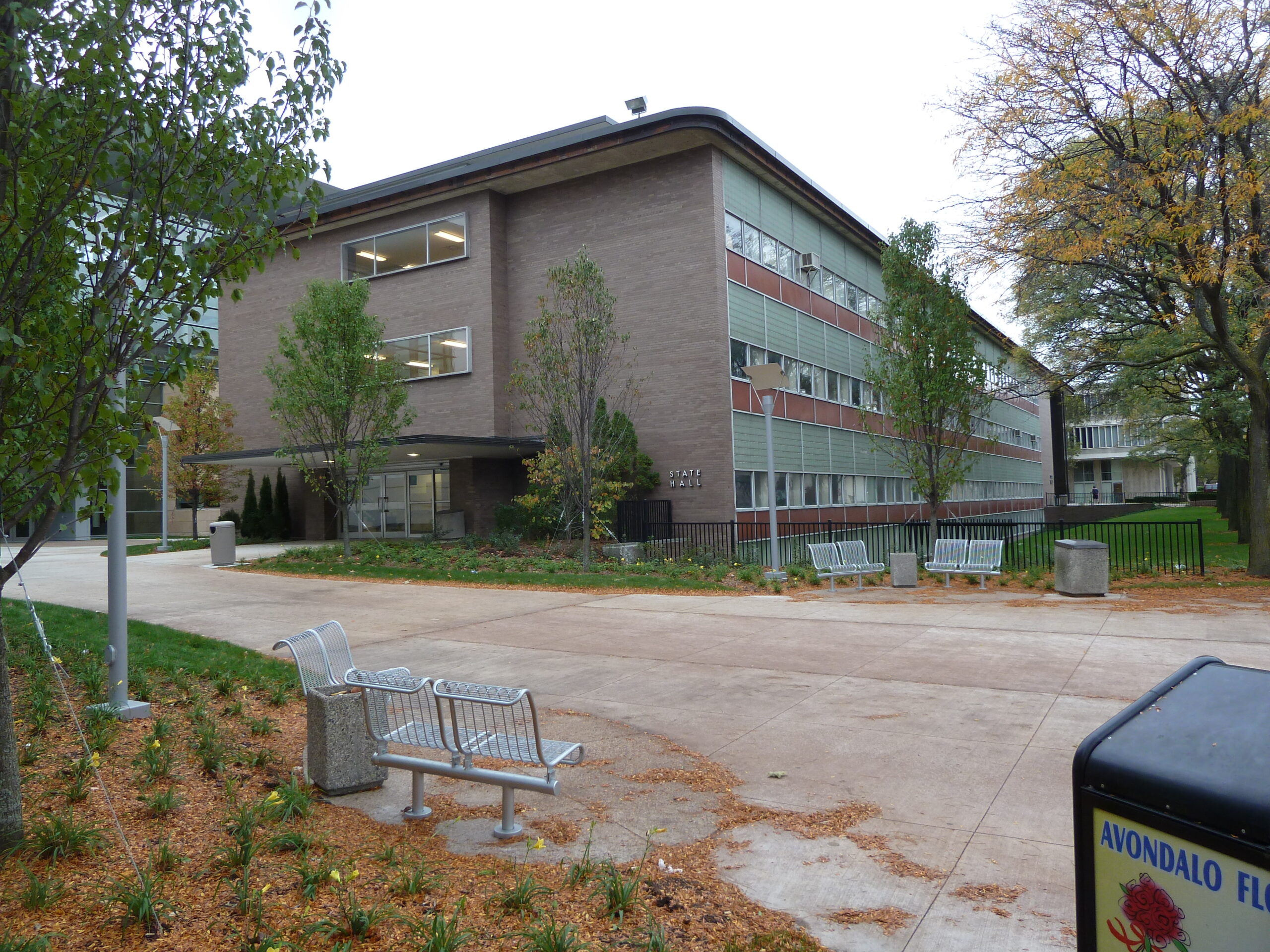
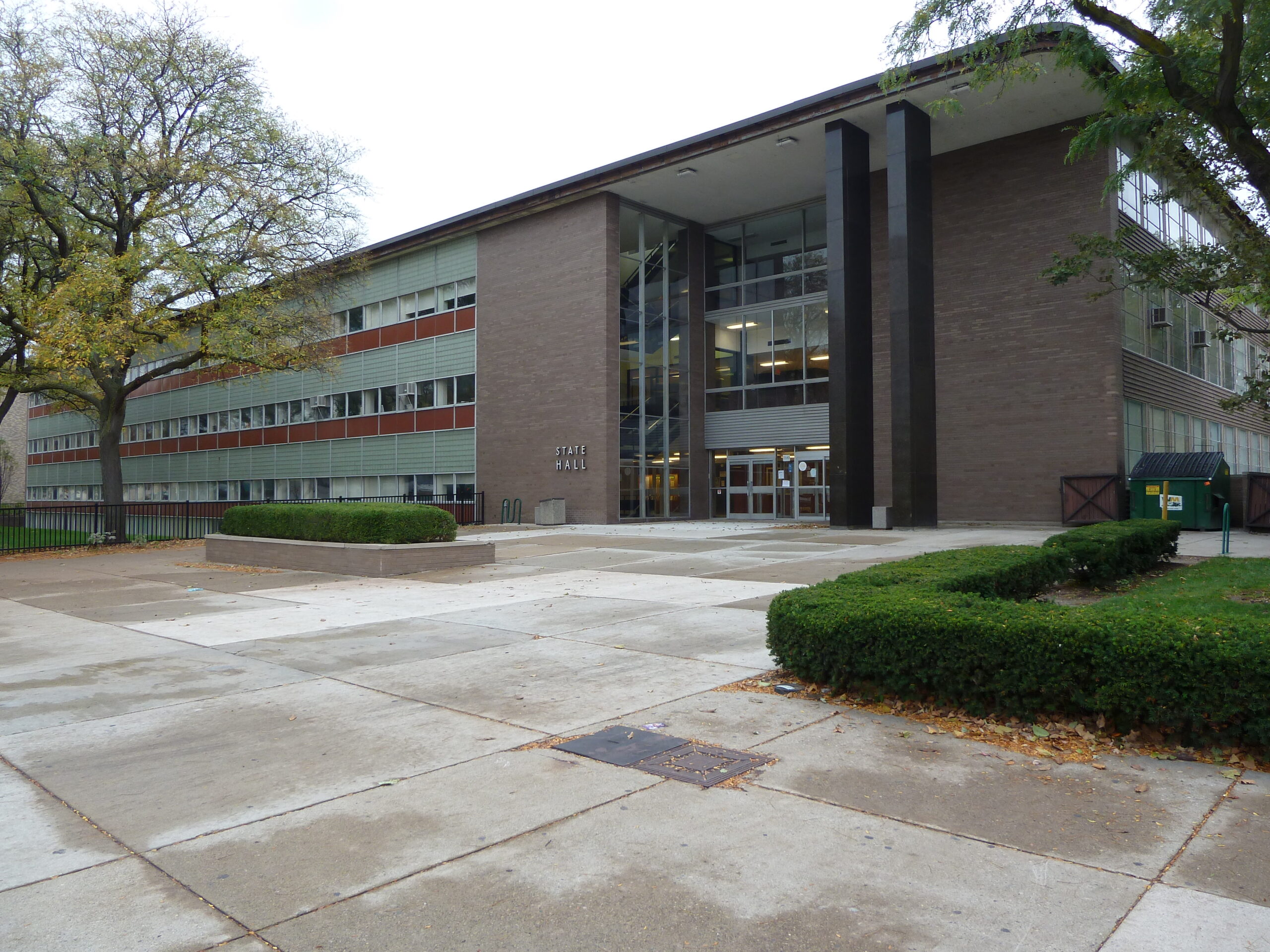

State Hall was the first building on the Wayne State University campus to be built explicitly for the university. The board of education of the city of Detroit provided the land, and the State of Michigan provided funds for its construction. Prior to naming it State Hall, the Detroit Board of Education considered giving it the name "Michigan Hall." Suren Pilafian designed State Hall while developing a master plan for the university. It was one of his first buildings as an architect. The structure was included in his master plan with its planned additions.
The groundbreaking for the $1 million-building was held on November 12, 1946, with Governor Harry Kelly turning the first shovel-full of dirt. A year after its completion, newly elected Governor G. Mennen Williams participated in a unique ceremony on campus to dedicate the new State Hall and bid farewell to his boyhood home which stood right next to it. It was torn down for future campus expansion projects. Governor Williams praised the new State Hall as well as Wayne State University's other plans for campus expansion stating that "all of us have to make way for progress and education. The only institutions which are permanent are the institutions of principle and spirit."
The original wing of State Hall featured twenty-five classrooms and four lecture halls. The classrooms themselves were designed to be separated by light soundproof partitions that could be installed and removed easily and inexpensively. The building's design as a flexible housing unit could readily be adapted to the changing needs of the university. Another unique innovation of Pilafian's design was an electrically operated window washer cab that was meant to ease the burden of cleaning the long expanse of windows on either side of the building. The cab was suspended from a monorail track that hung from the roof canopy of the building and when not in use could be stored away in a specially designed room on the third floor without removing the cab from its track. In 1957 a second wing was added along with a fourth story on top of the original 1946 wing at a cost of nearly $2 million. It should be noted that Pilafian designed both wings of State Hall around long hallways so that each classroom could have a window for ventilation since the structure originally had no air conditioning.
The present State Hall is an L-shaped structure of brick, concrete, steel, and glass that emulates the 1940s mainstream modernism that was popular around the time of its construction. Although Pilafian's design for State Hall is quite original, the fawn-colored banded brick wall, minimalist window composition, and glass and metal entrance tower somewhat resemble the modernist architecture of Eero Saarinen that was emerging during that same era.
(Text excerpted from the Wayne State University Walking Tour script developed by the City of Detroit Historic Designation Advisory Board staff.)