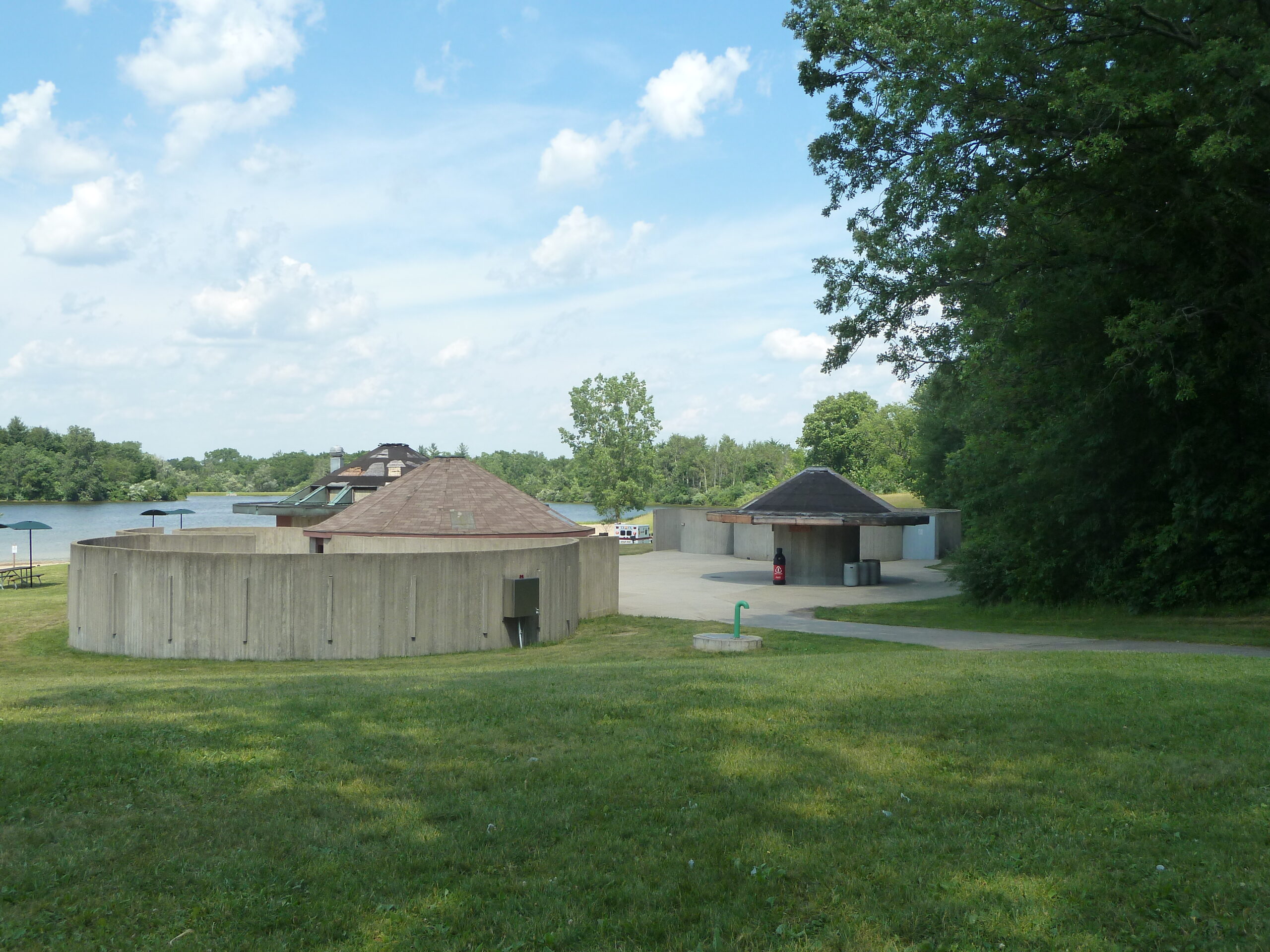


The Lower Trout Lake Bathhouse Complex and Contact Station/Bald Mountain State Recreation Area consists of a series of several structures sited in an open lawn setting against a stand of trees at the edge of Lower Trout Lake. The structures include an entry gatehouse, two bath houses/comfort stations and a concessions building to accommodate day users at the public beach. All of the buildings are circular in plan, some grouped or interlocked conveying an organic form. The exterior walls of the buildings are raw concrete, the graining of the vertically oriented wood forms providing a textured surface. The conical shaped roofs are supported on timber trusses and resemble parasols. Originally clad in copper, the roof covering has been modified to asphalt shingles on all but one building (the Concessions Building). Also, the deep projecting roof overhangs have been eliminated on the comfort station structures. The interlocking plan of the comfort station and their spiraling walls provide visual privacy for the users, thus minimizing the need for doors. The changing areas of the comfort stations are open to the air. Small changing compartments line the exterior walls and circular concrete benches provide seating. The materials used in the design of these structures were meant to be durable to withstand year-round exposure to the elements.
In the spring of 1964, the landscape and site planning firm of Johnson, Johnson and Roy began working with the State Building Division on a new day-use picnic and beach area development on Trout Lake within the Bald Mountain State Recreation Area. Planning for the new facility included road improvements between the site and M-24 as well as parking spaces for approximately eight hundred vehicles. Gunnar Birkerts and Associates was commissioned to provide the design for the various structures that would be required at the site. Construction, however, did not begin until 1968 with Gordon Mitton of Birkert's office providing the construction oversight. The park structures were designed using three basic materials: concrete, wood and copper. The selection of materials was to convey beauty, yet be permanent and durable. With the exception of the Concession Building the structures were treated as open-air facilities, where the walls would become "fences and the roofs acted and looked like umbrellas." The construction contract indicates the cost of the complex was approximately $250,000 and that the work was executed by the Roy L. Hanson Construction Company.
Gunnar Birkerts was born and educated in Latvia and emigrated to the United States in 1949. After working in the offices of Eero Saarinen, Donald Grieb, and Yamasaki, Leinweber & Associates he felt he had "listened long enough" and established his own firm with Frank Straub. Together they were commissioned for several projects including the 1300 Lafayette Apartments and the Marathon Oil Building, both in Detroit. In 1963 he parted with Straub and established Gunnar Birkerts and Associates in Birmingham, Michigan. It was also during the 1960s that he began teaching at the University of Michigan's architecture school. Over the next three decades Birkerts designed hundreds of buildings and was recognized with many awards. Birkerts dissolved Gunnar Birkerts and Associates in 1997 but has continued to practice to the present.