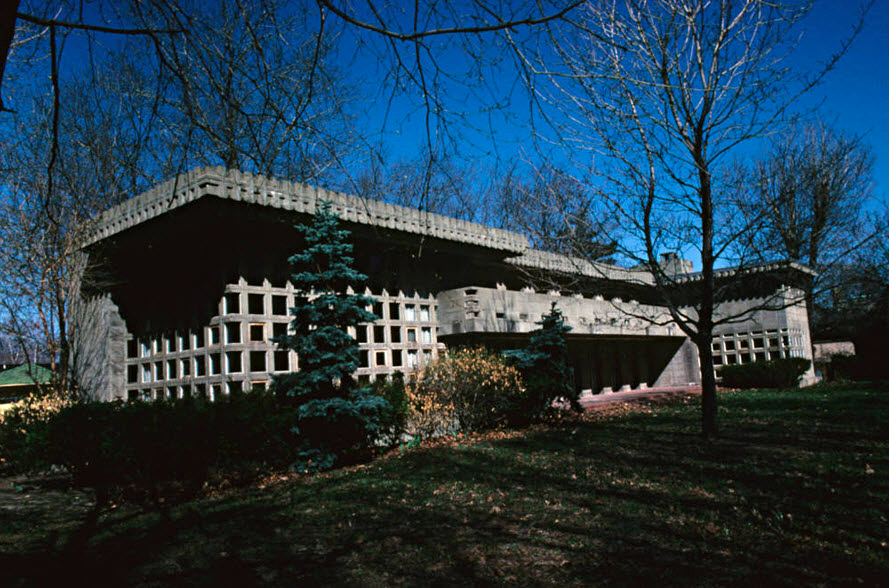
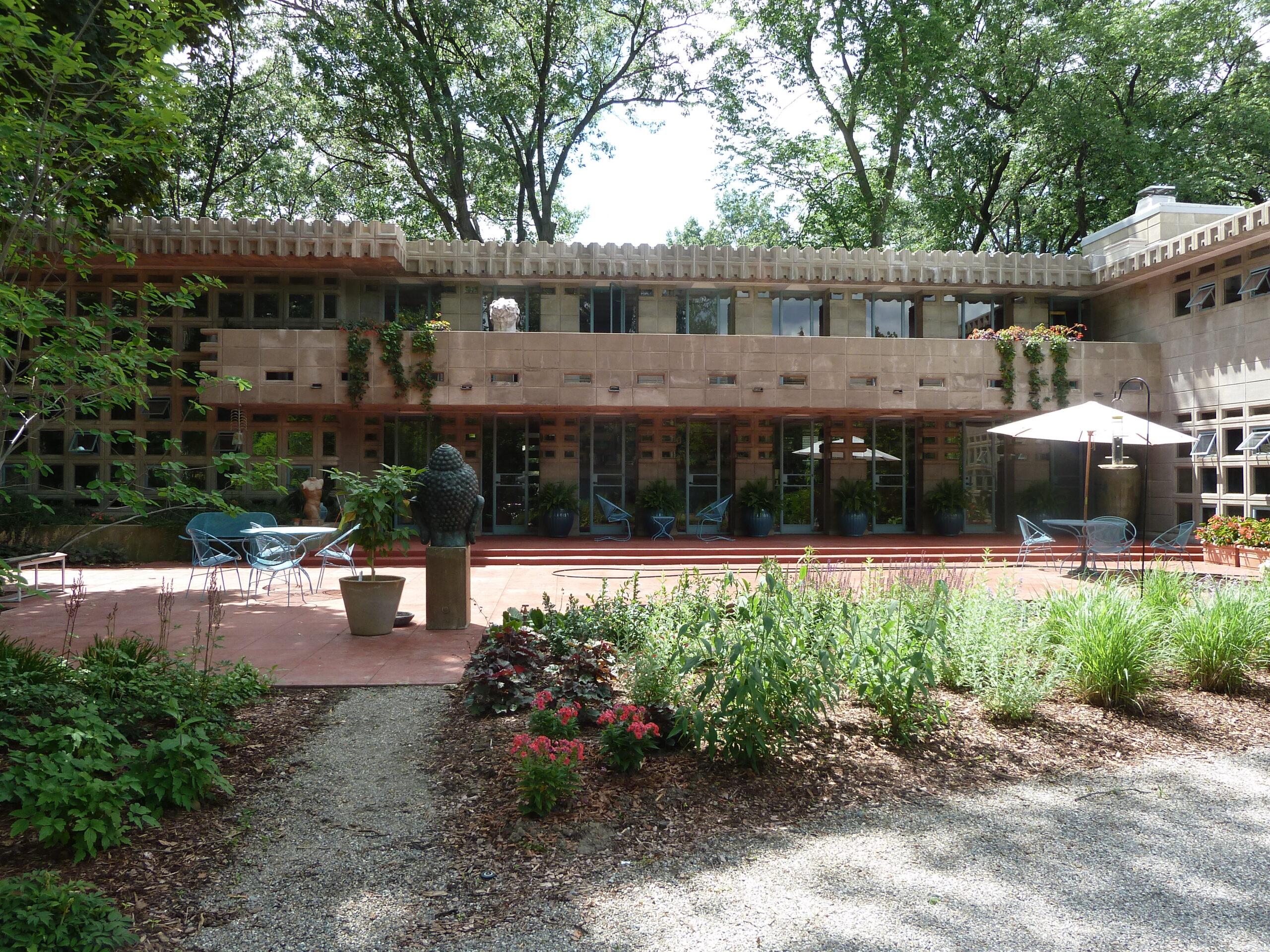
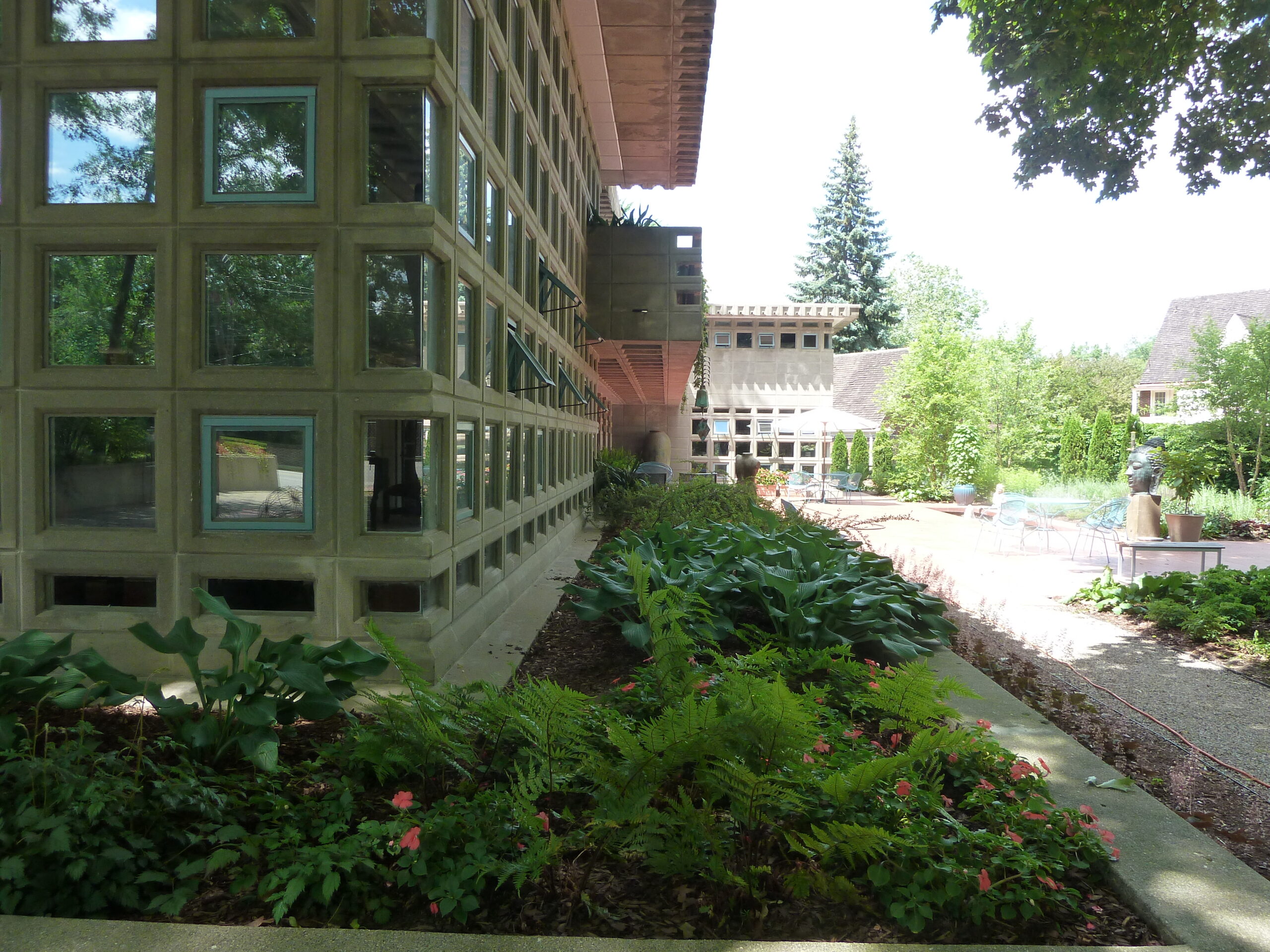
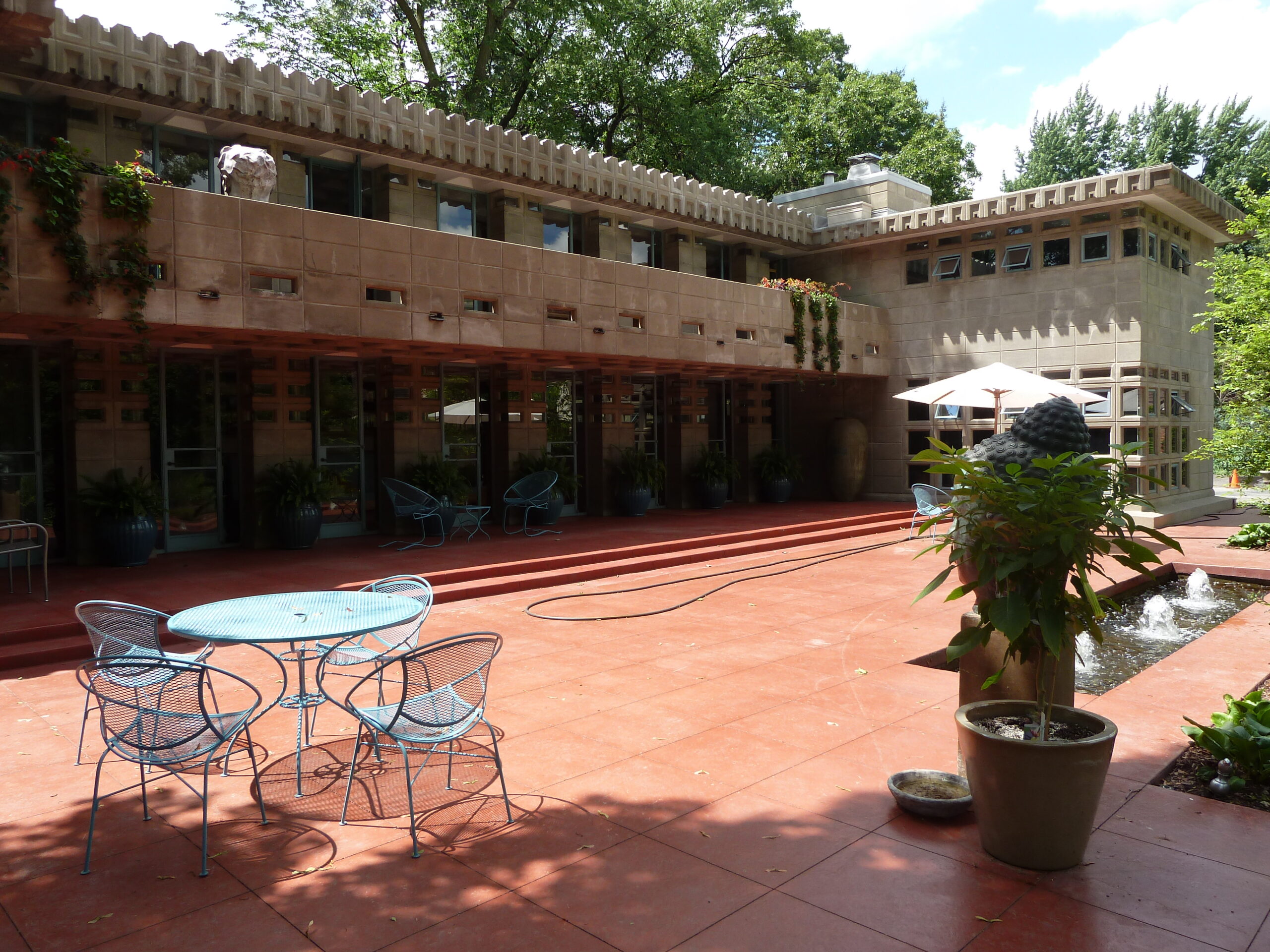
Like many Frank Lloyd Wright-designed houses, the Dorothy H. Turkel House features an understated main entrance on the west side. Perhaps the most prominent feature of the building is its cantilevered balcony, accessed by a series of steel-frame glass doors from a forty-eight-foot-long gallery on the second floor. Wright was an innovator, using techniques that are considered best practices in "green" building today. Mature shade trees and overhanging eaves shelter occupants of the Turkel House from the summer sun. Although air conditioning was becoming commonplace in homes of the wealthy by the 1950s, Wright avoided its use. He wanted to encourage circulation between interior and exterior spaces. Radiant sub-floor heating allows concrete surfaces to feel warm to the touch even when the thermostat is turned down in winter. Although not visible from the street, concrete surfaces of the ground-level terrace and the second-floor balcony are finished a bright red to contrast with the building's blue window frames. The interior is finished with architect-designed furniture, mahogany paneling, and built-in cabinets and other fixtures designed by Wright.
Completed in 1958, the Turkel House represents Wright's Usonian Automatic style and is perhaps the only two- story example of a building in that style. Wright began his career in 1888 as an apprentice with Louis Sullivan's firm Adler and Sullivan in Chicago. The firm was known for its commercial buildings, but Wright soon carved a niche for himself by taking on residential commissions. He established his own practice in 1893, developing a distinctive style based on simple geometry, horizontal lines, and open floor plans, and he became a leading practitioner of the Prairie school. His work in the Prairie style peaked by 1910, and, after a hiatus in Europe, he began to experiment with textile patterned concrete block systems in the Los Angeles area before promoting what he called "organic architecture." This is exemplified by masterpieces such as Taliesin West, built in 1937 in Scottsdale, Arizona, and Fallingwater, completed in 1939 in Pennsylvania. He began to develop his "Usonian" vision in the mid-1930s. Wright started designing "Usonian Automatic" homes – buildings of modest size that could easily and affordably be assembled on site from prefabricated materials – in the early 1950s. By using concrete block and minimizing interior and exterior finish work, Usonian Automatic structures were intended to avoid the high cost of skilled tradespeople, making the homes affordable to working class homeowners. Since only a handful of Usonian Automatic structures were ever built, Wright's innovative, prefabricated components were never mass-produced. Instead, they were cast on site and assembled by contractors at considerable expense. This house, commissioned by wealthy Detroit resident Dorothy S. Turkel, cost at least $65,000 to construct in 1956. Turkel had just finished reading Wright's book, The Natural House, in which he describes his ideal of organic architecture. She commissioned him to design a Usonian home. Usonian Automatic construction began with a concrete slab, and then continued from the ground up with courses of precast concrete blocks. Each block contained a semicircular groove along each of its unexposed faces. The courses were laid, without mortar, and then horizontal and vertical reinforcing rods were placed inside the grooves. Then the voids were filled with grout, tying the individual blocks together into a rigid, load-bearing wall.
(Text excerpted from the Detroit Driving Tour script developed by the City of Detroit Historic Designation Advisory Board staff.)