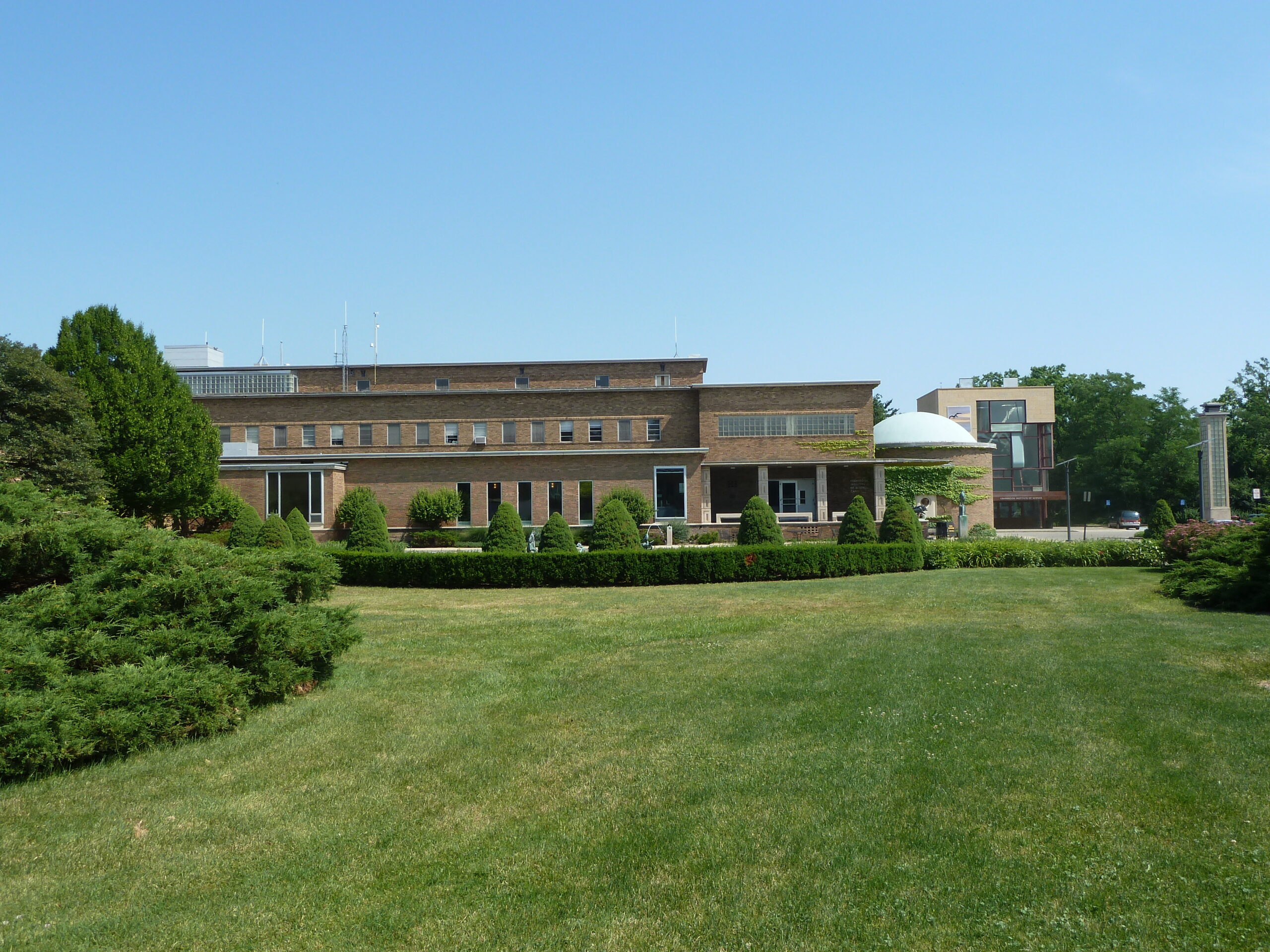
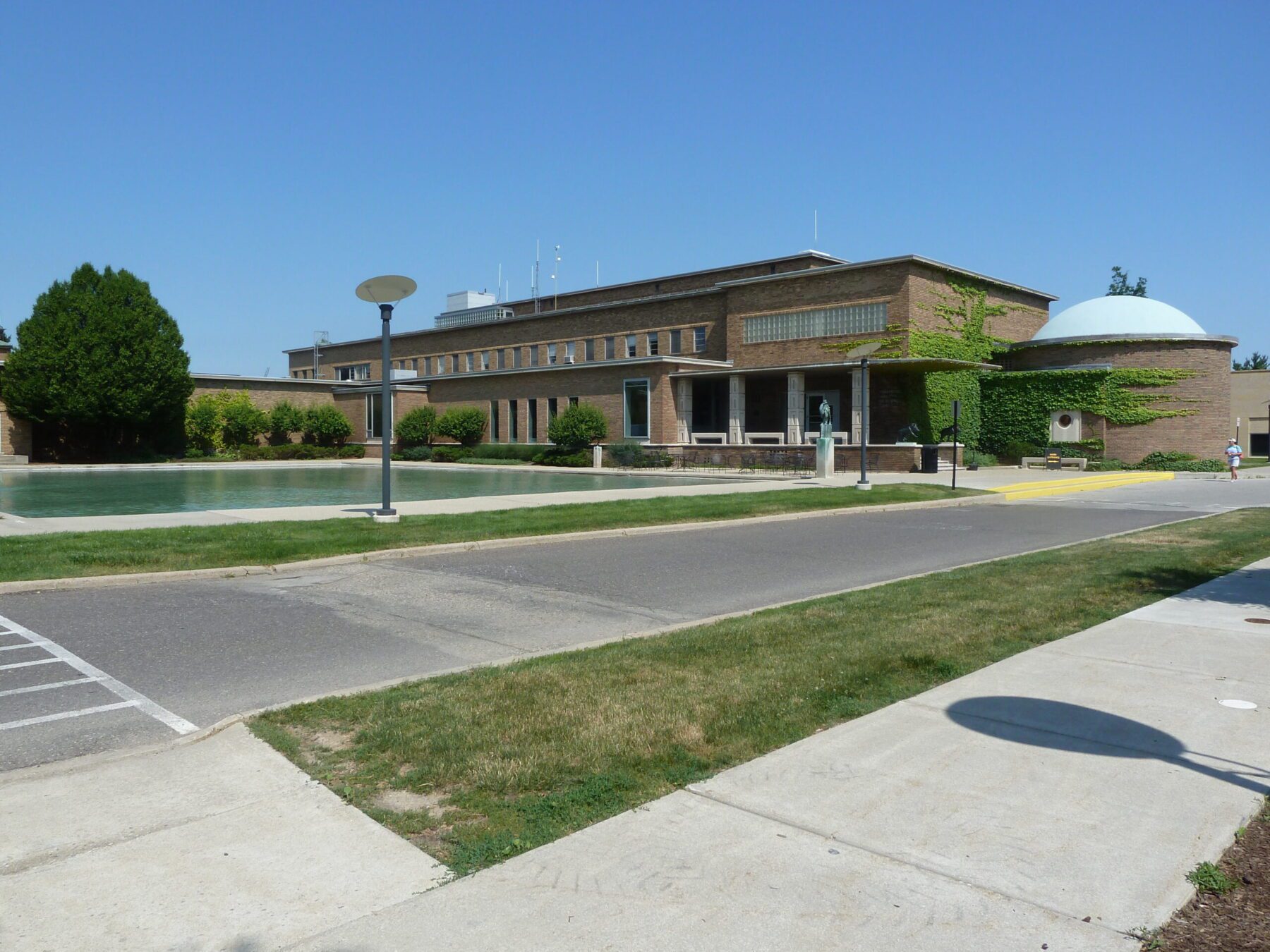

Built on the highest point on the Cranbrook campus, originally known as “Sunset Hill,” the Cranbrook Institute of Science is a sprawling L-shaped building that comprises portions of an original 1930 structure along with several additions. Upon approach to the building from the south, the visitor is first met with the historic Saarinen-designed elevation while the contemporary additions are set back or recessed towards the rear and west sides of the building. Typical of Saarinen’s work, the architecture is characterized by buff yellow brick and strong horizontal lines. The building’s horizontality is emphasized by the rhythm of its windows as well as the long thin cornices and overhanging flat roofs. The building is focused toward the large central reflecting pool that contains the Mermaid and Triton sculptures by Carl Milles. The round volumes and domes of the observatory and planetarium located at each end of the L-shaped plan provide balance to the otherwise strict angular geometry of the rest of the building. The building’s main entrance is located under an open porch at the northeast corner of the building. The porch has a thin flat slab roof supported by four concrete columns molded to appear as large patterned stacked blocks. East of the building is a large semi-circular parking area with the original concrete and glass block “light tower” at its center.
The Cranbook Institute of Science was envisioned in the late 1920s as the Cranbrook schools were in the final stages of completion. A desire by George Booth to add astronomy to the schools’ curriculum resulted in a plan to mount a telescope at the top of the school’s tower (now part of Hooey Hall). This location, however, was found to be unfit for an observatory, and the plans were put on hold.
Over the next several years, the Booths acquired several mineral collections during their travels in the American West. This further emphasized the need for a dedicated repository for the display of these collections and a need to study the natural sciences. In 1930 the Board of Trustees authorized the construction of “suitable buildings” for this purpose and proposed that “the Cranbrook Institute of Science” be established.
The institute’s first building, designed by George Booth, was a one-story, concrete block structure with a wood shingle roof. Booth intended this building to be temporary, fulfilling an immediate need until a more permanent solution could be realized. Looking forward, Booth asked Eliel Saarinen to develop a master plan for the future growth and expansion of the institute. This resulted in the development of several schemes. A revised plan was approved and the Saarinen-designed institute building was dedicated in May 1938.
According to historic images and a sketch plan held in the Cranbrook Archives showing the evolution of the building, Saarinen incorporated a small portion of Booth’s original structure into the new institute building. Booth’s original structure had a donut or U-shaped plan that encompassed the area where the pool is today. As the institute has grown, several additions or new wings have been added to Saarinen’s original design. Modifications include construction of McMath Planetarium in 1955, the addition of the Skilman wing in 1962 and a large contemporary wing designed by Stephen Holl in 1998.