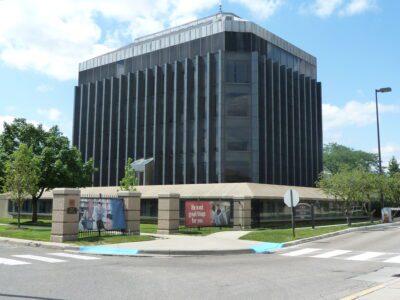
Considered a landmark of a new wave of post-World War II development in downtown Detroit, the City-County Building was one of the first major building projects in the city’s center since the Great Depression. Its style recalls Wallace Harrison’s influential United Nations Headquarters (1947-50) in New York City. Praised for its “clean lines and modern efficiencies,” it is an International style building complex composed of two principal masses: a twenty-story, vertically oriented Courts Tower containing thirty-eight courtrooms, and a fourteen-story, horizontally oriented Administration Tower with legislative chambers and an auditorium featuring a ninety-six-by-twenty-five-foot tall “window over downtown” in its anteroom. A glass connecting link joins the two towers, and contains the front and back entrances which are sheltered by an elongated yellow metal canopy that extends through the first floor to the sidewalks at both ends.
High-quality materials, columnar forms, and public art were integrated into the design of the City-County Building. Both towers are clad in white Vermont marble. Vertical strips of marble divide the taller Courts Tower’s front (river-facing) and rear elevations into full-height, repeating window bays, while the front and back elevations of the longer, lower Administrative Tower are marble-clad and contain regularly spaced, four-unit ribbon windows. The Woodward Avenue elevation is solely composed of blank marble panels, providing a backdrop to the Spirit of Detroit statue. The unadorned east wall, clad only in brick, contains two sets of ribbon window units on each floor, placed slightly offset to the north.
Known as the City-County Building when constructed, the building was renamed the Coleman A. Young Municipal Center (CAYMC) in memory of the city’s first African-American mayor upon his death in 1997. It remains one of the earliest and best examples of the International Style in Detroit and Michigan today.
Alvin E. Harley, Harold Ellington, and Clarence E. Day, were partners in the successful Detroit-based architectural and engineering firm, Harley, Ellington, and Day (1943-60). In addition to the CAYMC and the Veterans Memorial, the firm was also responsible for the Department of State Building in Washington, D.C. (1957-60), which was the largest building in Washington at the time of its construction. The firm has existed since 1908, first as Harley & Atcheson (1908-12); Harley Ellis Devereaux, its present manifestation, has enjoyed a successful practice since 2006.
(Text excerpted from the Civic Center/Financial District Walking Tour script developed by the City of Detroit Historic Designation Advisory Board staff.)