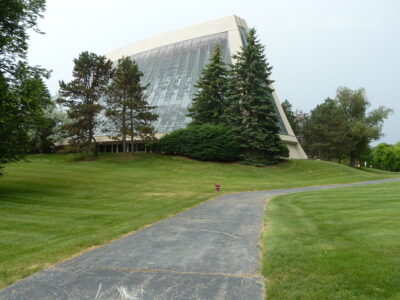
The Congregation Shaarey Zedek synagogue is sited on an expansive open bluff overlooking Northwestern Highway in Southfield. The dramatic and sculptural form of the sanctuary rises to a point above the flat landscape and has become a landmark for those traveling the busy highway. The steep galvanized metal roof over the sanctuary transitions to a much lower slope at two hinge-points on each side of building. A band of recessed stained glass windows separates the roof from the concrete and brick walls and gives the impression that the roof is floating above the structure. The abstract reference to a tent form or clasped praying hands is a relatively common design theme seen in several other examples of religious architecture built in Michigan during the 1950s and 1960s. The sanctuary wing, which is diamond-shaped in plan, is connected to the donut-shaped school wing to the north. A narrow hyphen between the two wings contains the main entrance to the building which is accessed from the adjacent parking area along the east side of the property. A remarkable reinforced concrete canopy with a flat roof and supported on two clusters of bent columns provides shelter to those dropping off worshippers at the main entrance.
Congregation Shaarey Zedek was founded in 1861 and worshipped in several locations throughout the city of Detroit during the late nineteenth and early twentieth centuries. In the early 1930s, the congregation decided to once again relocate in response to the movement of its congregates to more suburban neighborhoods. The congregation commissioned Albert Kahn Associates to design a Romanesque Revival structure for them at 2900 West Chicago Boulevard where they worshipped for thirty years before moving to their present location on Bell Road in 1962.
The existing modernist structure was designed by Percival Goodman with Albert Kahn Associates. Goodman was responsible for the overall design while Albert Kahn Associates completed the working drawings and all engineering for the project. Goodman who has been referred to as the nation’s leading synagogue architect during the mid-twentieth century was brother to noted writer and sociologist Paul Goodman. Between 1936 and 1979 Goodman designed more than fifty synagogues and religious buildings throughout the country. Percival Goodman studied at New York’s Beaux-Arts Institute of Design and then was encouraged by an employer to travel abroad and continue his studies at the Fontainebleau Ecole des Beaux Arts where he spent three summers. During his time abroad, Goodman was exposed to the European modernists and is said to have been deeply impressed by the work of Le Corbusier. He later accepted teaching positions at New York University and Columbia. It was his talk however at the 1947 Union of American Hebrew Congregation’s symposium on synagogue design that was pivotal in elevating his career as one of America’s foremost synagogue architects.
The dramatic design of the Shaarey Zedek structure has been recognized as one of the top ten breathtaking places of worship in the United States by Jamie Sperti of the San Francisco Examiner, who noted it was a “phenomenal example of 1960s futuristic architecture.”